Office building security services cost $25 to $45 per hour for unarmed guards and $35 to $65 per hour for armed guards in most US markets, and the hourly rate is only the start of the budget. Coverage hours, shift timing, and contract terms move the final number far more than the rate does. This guide breaks down what you’ll actually pay, why quotes for the same post can differ by $20 an hour, and how to build a security budget around your building instead of a vendor’s price sheet. If you want to see how Deploy structures its office building security services, start there, then come back here to check the math.
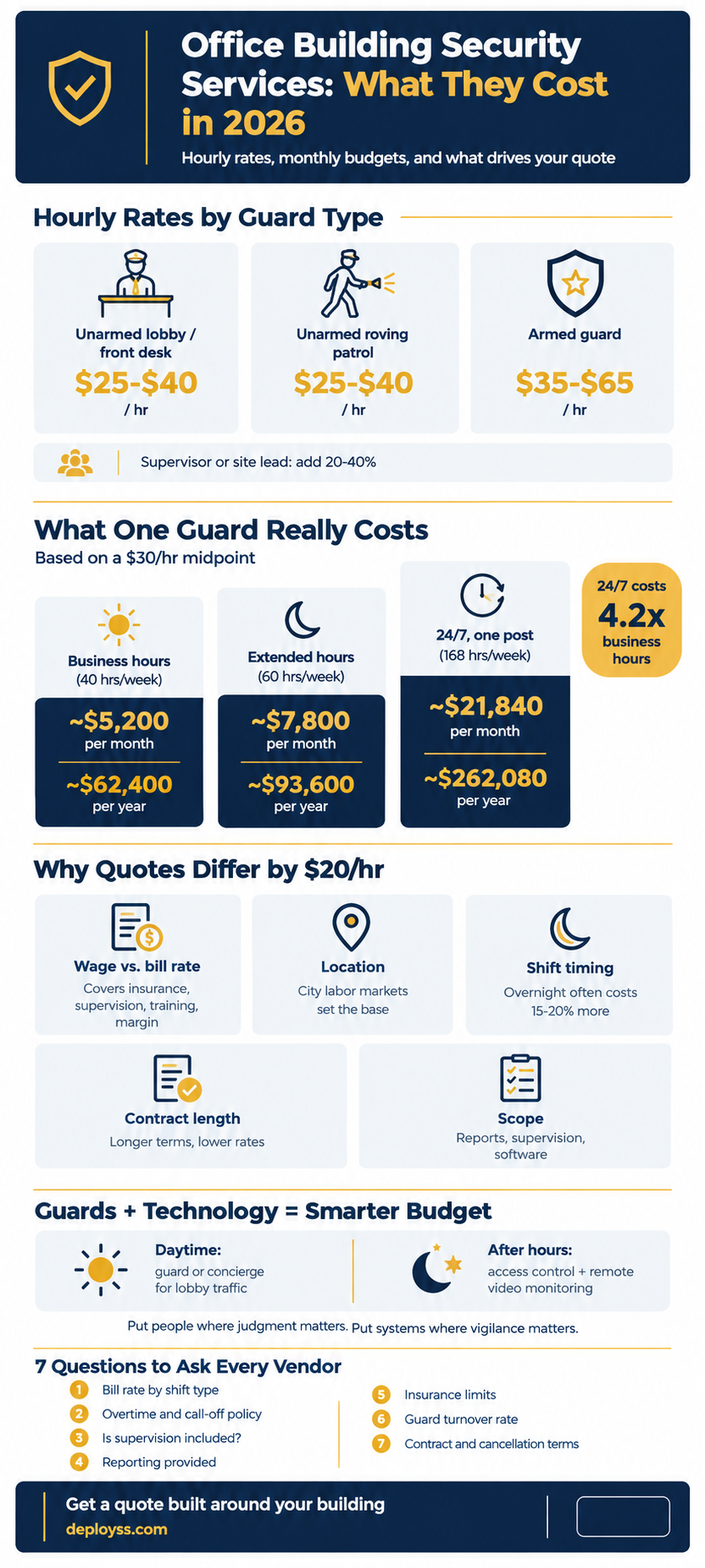
How much do office building security services cost?
Office building security services cost $25 to $45 per hour for unarmed guards and $35 to $65 per hour for armed guards, depending on city, shift, and contract size. One guard covering business hours runs roughly $4,300 to $7,800 a month. One post staffed around the clock costs about $18,200 to $32,800.
That’s the short answer. The longer one matters more, because the hourly rate is the least useful number in any quote. A property manager doesn’t approve “$32 an hour.” They approve a monthly line item, and the distance between the two is bigger than most people expect.
Published 2026 pricing guides land in a fairly consistent band. Several put unarmed guards at $20 to $40 an hour nationally. Armed guards start around $35 and climb past $100 for specialized work. Los Angeles-area guides run higher, with unarmed lobby coverage at $25 to $40 and armed at $35 to $65. One provider puts a guard in San Francisco or New York at $30 to $40 an hour for basic unarmed work, against $16 to $20 in rural Texas or the Midwest.
Your market sits somewhere inside those ranges. Where, exactly, depends on the things the rest of this guide covers.
What office building security services include
Before you can compare prices, you need to know what you’re pricing. “Security” in an office building isn’t one service. It’s a bundle, and vendors package it differently.
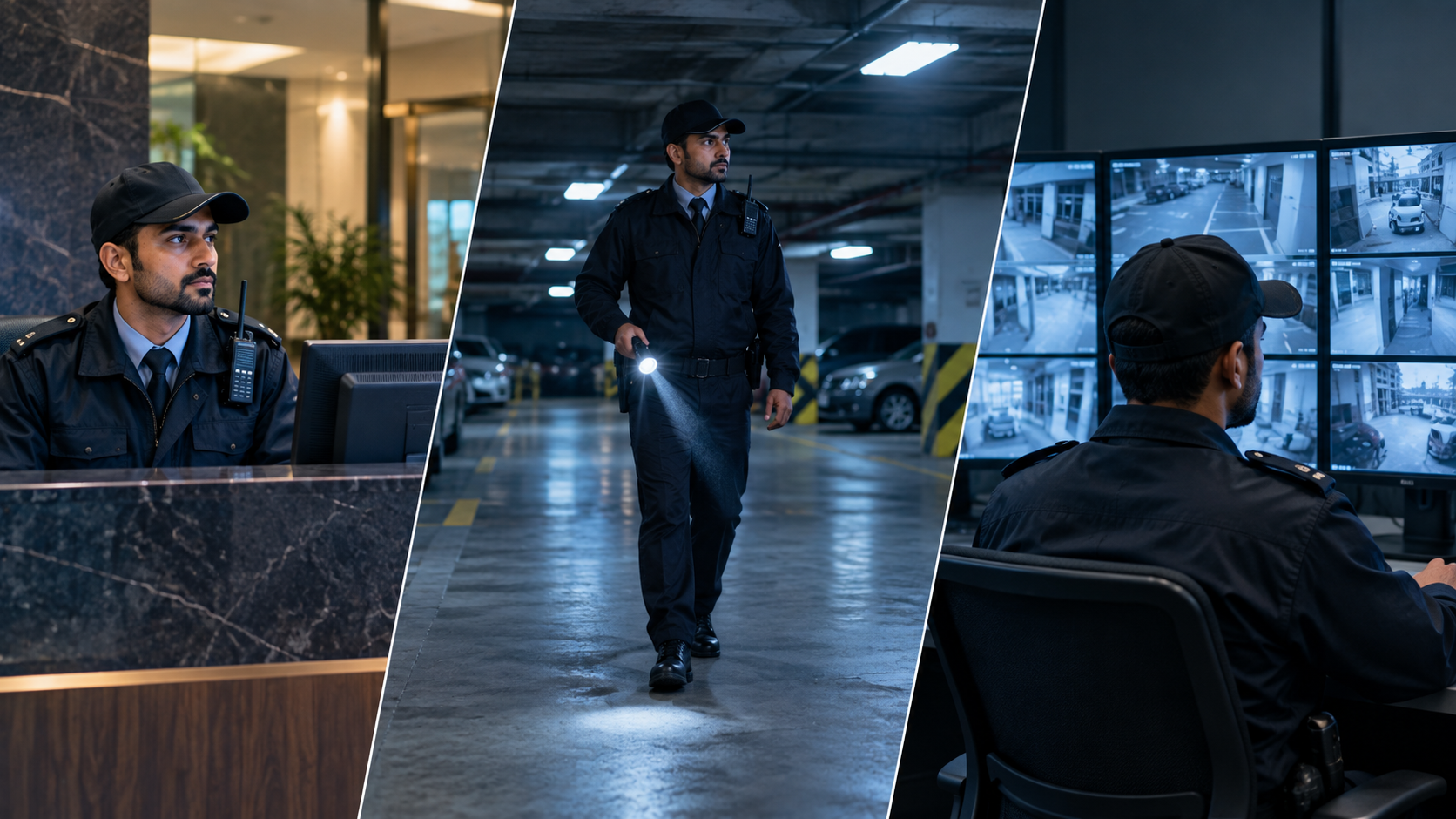
Lobby and front desk coverage. A guard or concierge at the entrance who checks visitors in, verifies badges, signs for deliveries, and answers the question every lobby gets: “Which floor is the dentist on?” This is the most common post, and the one most quotes are built around.
Access control. Managing who enters the building, which floors they can reach, and when. Guards enforce it at the desk. Card readers, turnstiles, and elevator controls enforce it electronically.
Visitor management. Logging guests, notifying the host, issuing temporary badges, and keeping a record. Some buildings handle this with a guard, others with a kiosk, and plenty use both.
Patrols. Interior rounds of stairwells, mechanical rooms, and common areas, plus exterior and parking structure walks. Patrols catch what a fixed post can’t see: propped doors, loitering, a broken lock.
After-hours protection. Overnight and weekend coverage, when the building is mostly empty and the risk profile changes. Cleaning crews, contractors, and the occasional tenant working late all need to be accounted for.
Incident response and reporting. What happens when something goes wrong, and the paper trail afterward. Good vendors file daily activity reports and incident reports without being asked. Weak ones make you chase them.
Emergency support. Fire alarms, evacuations, medical calls, power outages. A trained guard who knows the building’s emergency plan is the difference between a controlled evacuation and a crowd in the lobby.
Not every building needs all of these. A single-tenant office with light foot traffic might need a visitor system and an occasional patrol. A multi-tenant mid-rise usually needs the lobby post and some after-hours coverage. A downtown tower tends to need everything. Your scope is the first big cost lever, so decide it before you collect quotes.
Office building security services rates by guard type
The guard type sets the base rate. Here’s what the market looks like for office buildings:
| Post type | Typical hourly rate | Notes |
|---|---|---|
| Unarmed lobby / front desk | $25-$40 | The most common office post. Visitor check-in, badge checks, deliveries |
| Unarmed roving patrol | $25-$40 | Interior and parking structure rounds |
| Armed guard | $35-$65 | Higher-risk buildings, financial tenants, specific insurance or lease requirements |
| Supervisor / site lead | Add 20-40% | Not every contract needs one |
These are ranges, not quotes. A Class A tower downtown prices differently from a two-story suburban office park, and a vendor in Chicago will quote differently from one in Dallas.
Most offices don’t need armed coverage. If your real risks are unauthorized entry, tailgating, and after-hours access, an unarmed security guard covers them at a much lower rate. Armed guards make sense when a tenant handles cash or high-value assets, when your insurer or lease requires it, or when the building has a documented history of serious incidents. Paying armed rates for an unarmed risk is one of the most common ways buildings overspend.
What office building security services cost per month and per year
Here’s where the budget gets real. A guard isn’t a person. A guard is hours, and coverage hours multiply everything.
Using a $30 per hour bill rate as a midpoint:
| Coverage | Hours per week | Monthly cost | Annual cost |
|---|---|---|---|
| Business hours (8 hrs x 5 days) | 40 | ~$5,200 | ~$62,400 |
| Extended (12 hrs x 5 days) | 60 | ~$7,800 | ~$93,600 |
| 24/7, one post | 168 | ~$21,840 | ~$262,080 |
Same guard. Same rate. The 24/7 post costs 4.2 times the business-hours post, because there are 4.2 times as many hours to fill.
This is where plenty of buildings overspend. They start with “we need someone in the lobby” and end up with a 24/7 post when the real exposure sits between 7 a.m. and 7 p.m. and again after 10 p.m. Pricing those windows separately often cuts the budget more than any rate negotiation ever will.
The annual figure matters too, because it’s what finance sees. A $30 rate sounds modest. $262,080 a year for one around-the-clock post gets attention in a budget meeting, and you want to be the one presenting it, not the one explaining it afterward.
Why the same service gets quotes $20 apart
One Houston provider describes the problem plainly: one company quotes $38 an hour while another quotes $65 or more for what looks like the same service. It almost never is the same service. The gap usually comes from five places.
Wage versus bill rate. A guard in California might earn $17 to $21 an hour, but the bill rate you pay is noticeably higher. The difference covers payroll taxes, workers’ comp, liability insurance, supervision, training, scheduling, and the company’s margin. A low bill rate isn’t automatically a bargain. It can mean thin supervision or heavy turnover, and turnover costs you directly, because every new guard has to learn your building, your tenants, and your emergency procedures from scratch.
Location. Minimum wage laws and local labor markets set the base wage, and the bill rate follows. A rate that looks high in Omaha might be below market in Boston.
Shift timing. Overnight hours often cost 15 to 20% more, according to one Los Angeles provider. Weekends and holidays commonly carry premiums too, sometimes time-and-a-half. If your coverage includes a lot of nights, a flat rate in a quote should make you ask what’s been left out.
Contract length and volume. A 40-hour weekly post on a one-year contract prices lower than a handful of hours a week on a month-to-month basis. Vendors discount for predictability.
Scope. Does the post include access control software? Daily activity reports? A supervisor who visits the site? Those lines are exactly where two quotes diverge, and exactly where the cheaper one is usually hiding its savings.
What office buildings typically pay
Four realistic setups, all using the $30 midpoint. Your numbers will shift with your market, but the structure holds.
Small suburban office, one tenant. A single lobby guard from 7 a.m. to 6 p.m., Monday through Friday. That’s 55 hours a week, or roughly $7,150 a month. Many buildings this size skip the guard entirely and rely on a visitor management system. That’s a legitimate choice when foot traffic is light and the tenant knows everyone who walks in.
Multi-tenant mid-rise. A front desk guard during business hours, an evening patrol, and a weekend lobby shift. Call it 90 hours a week, around $11,700 a month. This is the most common profile, and it’s where scheduling efficiency saves the most. Overlapping shifts and idle hours are where the waste lives.
After-hours only. Coverage from 10 p.m. to 6 a.m., seven days a week. That’s 56 hours a week, about $7,280 a month before any overnight premium. Add 15 to 20% for the overnight rate and you’re looking at roughly $8,400 to $8,700. Buildings with strong daytime staffing and weak nights often start here.
Class A tower or high-visibility address. 24/7 lobby coverage ($21,840), a second guard during peak arrival hours (6 hours a day, five days a week, about $3,900), and an overnight roving patrol (56 hours a week, about $7,280). That lands near $33,000 a month. Add a staffed garage post and the number climbs fast.
If you manage a property portfolio rather than a single building, the same math applies across commercial properties, and the savings from consistent scheduling and one vendor add up quickly.
Guards versus technology: where the money goes
Guards handle what technology can’t: judgment, conversation, and a human presence when a tenant’s guest is lost or a delivery is stuck. Technology handles what guards are expensive for. Nobody should pay $30 an hour to stare at a locked door at 3 a.m.
That’s why many buildings run a hybrid. A guard or concierge covers daytime lobby traffic. After hours, access control and remote video monitoring cover the same building at a lower monthly cost than a staffed post. Remote monitoring typically costs less than a guard, though the exact price depends on camera count, monitoring hours, and response protocols. It also can’t greet a visitor or physically stop someone, which is why it works best as a layer instead of a replacement.
The decision isn’t guards or technology. It’s which hours need a person. Put a person where judgment matters, and a system where vigilance matters. Price both before assuming the answer is all guards, or all cameras.
The costs that don’t appear on the quote
The hourly rate is where quotes start. These are where they end up:
- Overtime and holiday pay. Guards who work holidays or cover a call-off often bill at 1.5 times the base rate. Ask what your contract says, and what happens when a guard doesn’t show up.
- Minimum shift lengths. Some vendors won’t staff a post for fewer than four hours. If you need a two-hour weekend shift, you may pay for four.
- Annual rate escalators. A 3 to 5% bump each year compounds over a multi-year contract. Negotiate the cap up front.
- Supervision fees. Some vendors include a field supervisor. Others bill for it separately.
- Training and onboarding. Building-specific orientation, post orders, and emergency drills sometimes carry a one-time fee.
- Equipment. Radios, tour wands, uniforms, and software can be bundled or itemized. Check which.
- Early termination. What does it cost to leave if the service isn’t working? Many contracts make this painful.
None of these is unreasonable by itself. The problem is the quote that omits them, and the budget that gets blown in month four.
How to compare office building security services quotes
Ask every vendor the same questions, in writing, and compare answers instead of prices:
- What’s the bill rate for each shift type, including overnight, weekend, and holiday?
- What’s the overtime and call-off policy? Who covers when a guard doesn’t show up, and how fast?
- Is supervision included? How often does a supervisor physically visit the site?
- What reporting do you get? Daily activity reports should be standard, with incident reports when something happens.
- What are the insurance limits, and can they name your property as additional insured?
- What’s the guard turnover rate on comparable accounts? A vendor who dodges this one has already answered it.
- What are the contract terms, including cancellation notice, escalators, and minimum commitments?
- Who are the guards? Licensing, background checks, and training standards should be documented, not promised.
If the cheapest quote can’t answer these cleanly, it isn’t the cheapest quote. It’s the one with the costs you haven’t found yet.
Also ask for a site walk before anyone prices your building. A vendor who quotes without seeing the lobby, the loading dock, and the garage entrance is guessing, and you’ll be the one paying for the guess.
How to reduce costs without cutting coverage
You can lower your spend and keep the protection. These moves tend to work.
Price exposure windows, not whole days. Look at when incidents and risk actually occur. If a 24/7 post is really needed for 16 hours a day, moving the other 8 to remote monitoring and access control saves 56 guard hours a week. At $30 an hour, that’s about $7,280 a month, or $87,360 a year, before the cost of the technology that replaces it. That technology costs real money, but it’s rarely more than the post it replaces.
Right-size the guard type. If your risks are visitor screening and access, don’t pay for armed coverage. Reserve it for sites that demonstrably need it.
Sign longer terms for a lower rate. If you’re confident in the vendor, a multi-year agreement with a capped escalator usually beats month-to-month pricing.
Fix the schedule, not the rate. Overlapping shifts, split posts, and idle hours are where budgets leak. A scheduling review often saves more than switching vendors.
Bundle services. Patrols, lobby coverage, and after-hours monitoring from one vendor generally cost less than three separate contracts, and you get one point of accountability.
Invest in the visitor system. A good check-in process reduces what the lobby guard has to do, which can mean fewer hours of coverage during slow periods.
Frequently asked questions
How much do office building security services cost per hour?
Typically $25 to $45 per hour for unarmed coverage and $35 to $65 for armed, with major metros at the high end. Rural and lower-cost markets can run below $20 for basic unarmed work.
How much does 24/7 office building security cost?
Staffing one post continuously is 168 hours a week. At $25 to $45 an hour, that’s roughly $18,200 to $32,800 a month per post, or about $218,400 to $393,120 a year.
Are armed guards necessary for an office building?
Usually not. Most office risks, including unauthorized entry, theft, and visitor screening, are handled by unarmed guards. Armed coverage tends to apply to higher-risk tenants, cash handling, or specific insurance and lease requirements.
Why is the bill rate higher than what the guard earns?
The bill rate covers payroll taxes, workers’ compensation, liability insurance, training, supervision, scheduling, and company overhead and margin. A guard earning $18 an hour might bill at $30 or more.
Is a security guard or remote video monitoring cheaper?
Remote monitoring typically costs less than a staffed post, especially after hours. But it can’t greet visitors or intervene physically, so many buildings combine the two.
Do I need a contract for office building security services?
Most vendors require one, usually from several months to a year or more. Longer terms often lower the rate, but check cancellation terms and annual escalators before you sign.
What should an office building security guard do?
Core duties include checking in visitors, verifying badges and credentials, monitoring entrances, handling deliveries, patrolling common areas, responding to alarms and incidents, and filing reports. The exact duties are set in a document called post orders, which should be written specifically for your building.
Get a quote built around your building
Rates give you the range. Your coverage hours, building type, and exposure windows decide where you land inside it. Deploy builds office building security services around the way your property actually operates, from a single lobby post to full 24/7 coverage. Contact us for a site walk and a quote that itemizes everything covered above, so you can compare it to any other bid on the table.