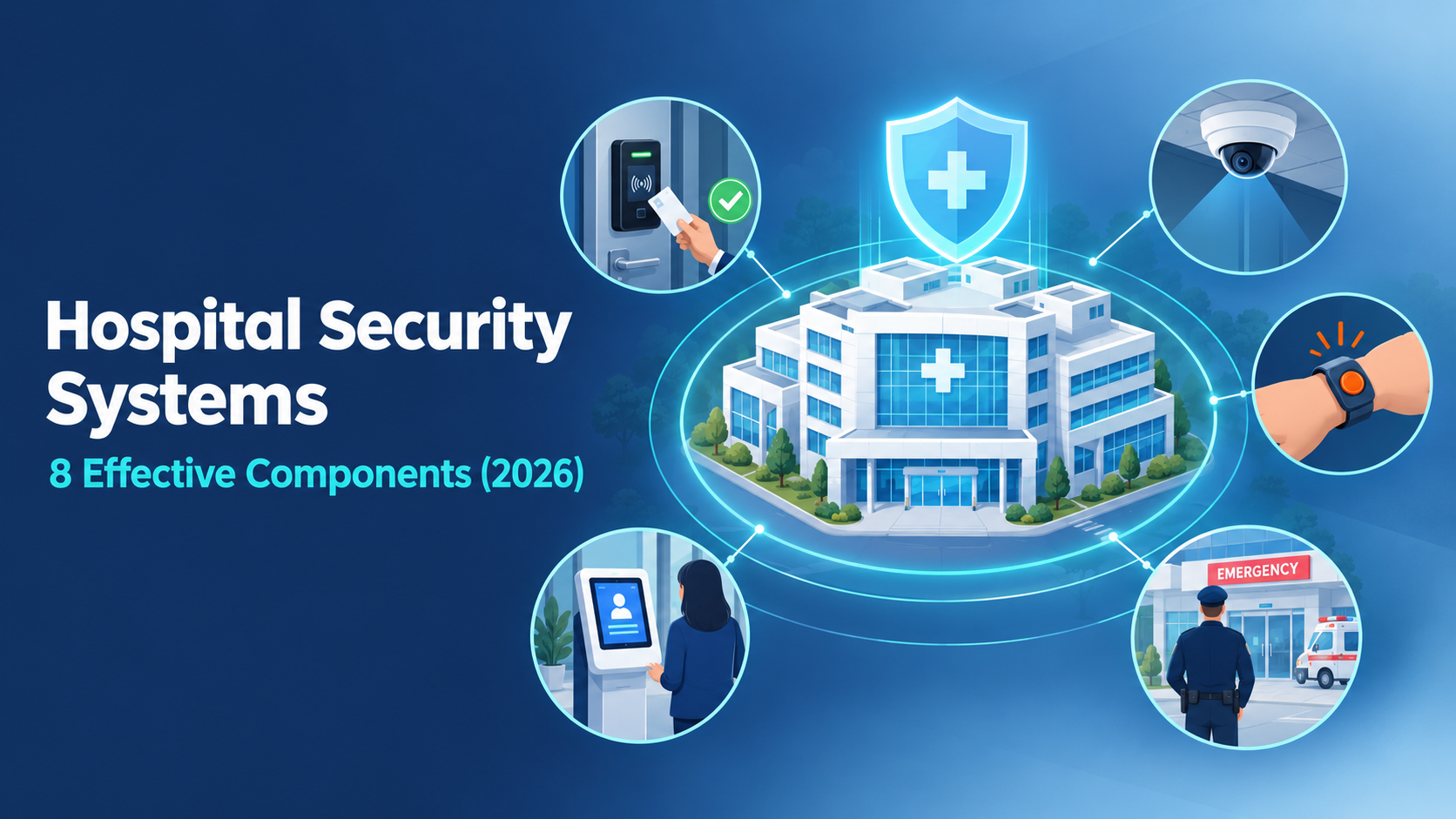
Hospital Security Systems: The Complete Guide to Components, Compliance and Costs
By the Deploy Security Services team. Updated October 12, 2026. About 15 minutes to read.
Hospital security systems are the combination of technology, written procedures and trained people that protect patients, staff, visitors, medications and data inside a healthcare facility. A strong setup never depends on a single camera or a single locked door. It layers access control, video surveillance, alarms, emergency communication and on-site security officers, so that when one layer fails, another one catches the problem.
This guide to hospital security systems walks through every layer, the rules hospitals have to meet, what drives the price and how to build a plan that fits your building. It is written for hospital administrators, facility and safety managers, and security directors who need practical answers, not a sales pitch.
Disclosure: Deploy Security Services provides trained security officers and fire watch for healthcare facilities. We have kept this guide neutral on hardware brands, and where we mention our own services we say so.
Key takeaways
- Hospital security systems work best as layers: access control, video, alarms, notification and people, each covering the gaps of the others.
- In hospital security systems, technology only detects. Trained officers and clear response procedures turn an alert into an outcome.
- Since January 2022, Joint Commission standards expect accredited hospitals to run a documented workplace violence prevention program, including an annual worksite analysis.
- Start with a risk assessment of your own building before choosing hospital security systems. Buying equipment first is the most common and most expensive mistake.
- Judge hospital security systems by their total cost over five to seven years, including staffing, licenses, maintenance and training.
In this guide
- What hospital security systems include
- Why hospitals face unusual security risks
- The eight core components
- The human layer: security officers
- Technology, officers or both: a comparison
- Compliance and standards
- How to plan your hospital security system, step by step
- What hospital security systems cost
- Common mistakes with hospital security systems
- Frequently asked questions
What hospital security systems include
Think of a hospital security system as three connected parts:
- Prevention: things that stop an incident from starting, such as controlled doors, visitor screening, lighting, signage and visible officers.
- Detection: things that notice a problem quickly, such as cameras, door alarms, duress buttons, infant tags and analytics.
- Response: the people and procedures that act once something is detected, such as security officers, nursing staff, lockdown protocols and coordination with police.
Most weak hospital security systems are strong in one part and thin in another. A hospital with excellent cameras but no one watching or responding has detection without response. A hospital with many guards but no access control has response without prevention. The goal of complete hospital security systems is balance.
Hospital security systems also differ from those in an office or warehouse because they must never get in the way of care. A door that slows a nurse during a code, or a screening step that delays a patient in pain, creates its own risk. Good design protects people while keeping clinical workflow moving.
Why hospitals face unusual security risks
A hospital is open around the clock, welcomes thousands of strangers and holds some of the most tempting assets in any building. Several features combine to raise the risk, and they shape how hospital security systems must be designed:
- Public access by design. Emergency departments, waiting rooms, parking structures and visiting hours mean the front door is rarely closed.
- High-value and high-risk areas. Pharmacies and medication rooms hold controlled substances. Nurseries and NICUs hold the most vulnerable patients. Records rooms and server closets hold protected health information.
- Emotionally charged situations. Fear, pain, long waits, substance use and mental health crises can all lead to aggression.
- Mixed populations. Patients, families, vendors, volunteers, students and contractors all need different levels of access.
The human cost is significant. The Joint Commission has noted that roughly 73 percent of nonfatal workplace injuries and illnesses that lead to missed work in healthcare are connected to workplace violence. That figure is a large part of why accreditation standards changed, which we cover below.
The risk is also physical and immediate. When Windsor Regional Hospital in Ontario began screening people at its emergency department entrances, staff reported finding about 20 knives and other sharp items on people each day in the early weeks. Not every hospital sees numbers like that, but the example shows how much can walk through a front door unnoticed.
The eight core components
1. Access control and badge systems
In hospital security systems, access control decides who can go where, and when. In a hospital this usually means dividing the building into zones:
- Public zones: lobbies, cafeterias, waiting rooms.
- Controlled zones: inpatient units and clinical corridors, open to staff and escorted visitors.
- Restricted zones: pharmacy, NICU, operating rooms, labs, data rooms and anywhere controlled substances are stored.
Restricted zones deserve stronger verification than a simple badge tap. Many hospitals add a PIN or biometric check for pharmacies and newborn units.
The credential itself matters too. Some of the most widely deployed older proximity cards can be cloned with inexpensive tools, a vulnerability that healthcare facility management groups have highlighted in recent education sessions. Newer encrypted cards and smartphone credentials using Bluetooth or NFC reduce that risk and are also touchless, which helps infection control. When you upgrade, choose readers that support more than one credential type so you can migrate staff gradually instead of re-badging everyone overnight.
Two details are easy to miss. First, access control must connect to the fire alarm so doors release when life safety requires it, and that connection has to be tested on a schedule. Second, badge lifecycle is a security control: revoke access the same day someone leaves, and audit active badges every quarter to remove dormant ones.
Go deeper: hospital access control systems, healthcare badge security and choosing access control readers.
2. Video surveillance
Cameras serve three jobs in hospital security systems: deterrence, real-time awareness and evidence after an incident. The usual priority locations are:
- Emergency department entrances and triage areas
- Main entrances, loading docks and ambulance bays
- Parking lots and garages
- Pharmacies, medication rooms and supply areas
- Newborn nurseries and maternity unit exits
- Corridors, stairwells and elevator lobbies
Privacy is the part that needs the most thought. Cameras do not belong in patient rooms, restrooms or treatment areas where people expect privacy, and any system should be backed by posted signage, a written policy on who can view and export footage, and regular audits of access to recordings. Some public health agencies publish detailed video monitoring policies that cover notice, viewing rights and storage, and they are worth reading as a model.
Retention is a policy choice shaped by cost and by state requirements. Industry surveys have found that 30 days is a common retention period, but hospitals that handle frequent claims or investigations often keep footage longer for key areas. Confirm the requirement with your legal and risk teams.
Finally, decide who is watching. Footage that no one reviews is only useful after the fact. Analytics such as loitering detection, tailgating alerts and license plate recognition can help a small team cover a large campus, but they work best when a trained person is assigned to respond.
Go deeper: hospital video surveillance and AI video analytics for hospitals.
3. Visitor management
Visitor management in hospital security systems answers a simple question: who is in the building, and why? Paper sign-in sheets cannot answer it. A digital system can:
- Check visitors in at a front desk or kiosk and scan an ID
- Print a badge that shows the visitor’s name, destination and an expiry time
- Limit a badge to specific floors or units
- Track check-out with a scannable code, so the hospital knows who is still inside during an emergency
- Enforce visiting hours and restrictions, such as no visitors for a specific patient
Treat contractors and vendors as a separate category with escort rules. They often have broad physical access and are a frequent source of tailgating through secured doors.
Go deeper: hospital visitor management systems.
4. Infant and pediatric protection
Infant abductions are rare, but they are among the most serious events a hospital can face, so almost every maternity unit builds infant protection into its hospital security systems. Typical measures include:
- A small tag on each baby’s ankle that triggers an alarm if the infant approaches a monitored exit
- Automatic door locks and elevator holds when an alarm sounds
- Mother-baby matching tags that alert staff to a mismatch
- Strict staff identification, because abductors have often posed as nurses or other hospital employees
- Regular drills so every shift knows its role in a infant alert
The technology helps, but the culture matters just as much. Parents should be told to ask for identification from anyone who wants to take their baby, and staff should feel comfortable challenging an unfamiliar face.
Go deeper: infant security systems.
5. Weapons detection and emergency department screening
Emergency departments see the highest volume of violent incidents in many hospitals, so a growing number of hospital security systems now include walk-through weapons detection at emergency entrances. Modern systems use sensors and software to tell threats from everyday items such as phones and keys, so people can keep walking instead of emptying their pockets. Hospitals in Canada and the United States have reported large screening volumes and regular removal of prohibited items after installing them. One Alberta hospital system reported more than 56,000 scans at a single emergency department in its first months of use.
It is not the only approach. Some large hospitals have decided that detection gates are not the right fit and focus instead on de-escalation training, wearable panic buttons and body-worn cameras for officers. If you are weighing screening, plan for:
- Staffing: someone must monitor the gate and handle alarms.
- Throughput: emergency patients cannot wait in a line.
- Accessibility: wheelchairs, walkers and medical devices need a respectful process.
- Policy: what happens when a patient or visitor refuses screening.
- Communication: clear signs and a script for staff.
Go deeper: weapons detection in hospital emergency departments.
6. Duress alarms and panic buttons
When a clinician is in a room with an agitated patient, reaching for a phone is not realistic. Wearable duress buttons, often built into an ID badge, let staff call for help silently. Fixed panic buttons at reception desks, triage stations and pharmacy windows do the same job.
Within hospital security systems, a duress system is only as good as its response. Check that the alert shows an accurate location, that it reaches both the security desk and a nearby backup, and that it is tested at least monthly. Staff also need to trust it. If past alarms went unanswered, people stop pressing the button.
Go deeper: panic buttons and duress alarms for hospital staff.
7. Emergency notification and lockdown
During an active threat, fire, severe weather event or utility failure, a hospital must reach hundreds of people fast without causing panic among patients. Emergency notification systems in hospital security systems send messages by overhead page, text, email, desktop alert and digital signs, often with preset scripts for each type of event.
Many hospitals also use internal color codes to signal different emergencies. The codes vary between hospitals, which is why a visiting traveler nurse or contractor needs to learn yours. Lockdown capability matters too: the ability to secure a single unit, a wing or the whole campus quickly, from the security console, while keeping paths open for life-saving care. Run joint drills with local police and fire services so entry points, staging areas and handoffs are agreed before a real event.
Go deeper: hospital emergency notification and lockdown.
8. Security operations and monitoring
The control room is where all the other components of hospital security systems come together: video feeds, door alarms, duress alerts and radio traffic. Whether it is staffed in-house, by a contractor or by a remote monitoring center, the questions are the same:
- Who is on duty at every hour, including holidays?
- How quickly is an alert acknowledged, and who decides what happens next?
- Are incidents logged consistently so trends can be analyzed?
- What is the backup if the network or power fails?
Go deeper: hospital security monitoring services.
The human layer: security officers
Every component of hospital security systems creates information. People turn that information into action. Trained security officers walk the corridors, greet visitors at entrances, escort staff to their cars at night, respond to duress alarms and calm situations before they escalate.
What good hospital officers do differently from officers at an office park:
- De-escalate first. The aim is to reduce tension with patients and families, not to win a confrontation.
- Understand clinical settings. They know which areas need quiet, which doors must stay open and when to step back for a medical team.
- Support compliance. They document incidents, follow visitor policy consistently and help with the safety rounds that accreditation surveyors look for.
- Cover life safety gaps. When a fire alarm or sprinkler system is out of service for repairs, authorities often require a fire watch, meaning trained personnel who patrol and watch for fire until the system is restored.
Whether officers are armed is a policy decision that depends on your risk assessment, state law, local police relationships and board preferences. Many hospitals use unarmed officers with strong de-escalation training and bring in armed personnel only for specific, higher-risk situations. Whatever you choose, document it in writing.
Many facilities mix employed officers with contract providers to cover vacancies, special events and surge periods. If you consider a contractor, ask about screening and licensing, healthcare-specific training, supervision, insurance, scheduling backup when someone calls out and how they report incidents to you.
Deploy Security Services provides trained security personnel for hospitals and healthcare facilities, supporting access control and visitor management, emergency response and surveillance monitoring, with plans tailored to each facility’s layout, visitor flow and emergency procedures. Learn more about our hospital and healthcare facility security services or request a quote to discuss your site.
Technology, officers or both: a comparison
Buyers of hospital security systems often ask whether to spend on equipment or on people. The honest answer is that each does something the other cannot. We provide officers, so we have a stake in this question, and the table below is meant to be a fair comparison.
Technology only | Officers only | Integrated approach | |
|---|---|---|---|
Detection | Fast and constant across many points | Limited to what people can see | Technology finds it, people confirm it |
Response | Alerts only; no one to act | Immediate, on-site, flexible | Alert routed to the nearest officer |
Deterrence | Visible cameras and locks help | Strong when officers are visible | Strongest combination |
Evidence | Recorded video and access logs | Reports and witness accounts | Footage plus a trained witness |
Handling people | Cannot de-escalate | Can calm and redirect | Officers guided by live information |
Cost pattern | Higher upfront, lower ongoing | Lower upfront, higher ongoing | Balanced and scalable |
Main weakness | Alarms nobody answers | Cannot be everywhere at once | Needs planning and integration |
Best fit | Small clinics with low risk | Very small sites with limited budgets | Hospitals and large campuses |
The integrated model is the most effective approach to hospital security systems, which is why the sections above treat equipment and officers as one system rather than competing options.
Compliance and standards
Requirements for hospital security systems vary by country and state, so treat this section as a starting point and confirm details with your compliance officer.
Joint Commission workplace violence standards. For accredited hospitals and critical access hospitals in the United States, new and revised requirements took effect on January 1, 2022 across the Environment of Care, Human Resources and Leadership chapters. They expect hospitals to:
- Run a workplace violence prevention program led by a designated individual and developed by a multidisciplinary team
- Perform an annual worksite analysis and act on its findings
- Monitor, report and investigate security incidents, including workplace violence
- Train leaders, staff and licensed practitioners at hire, every year and whenever the program changes, covering prevention, recognition, response and reporting
Before citing a specific requirement number to a surveyor, check it against your current accreditation manual.
OSHA guidance. Federal OSHA guidance on workplace violence in healthcare is advisory rather than a rulebook, but some states have added their own legal requirements, so check where you operate.
HIPAA Security Rule. The physical safeguards cover facility access controls, workstation security and handling of devices and media. Access logs, controlled records rooms and secured workstations all support this.
Controlled substances and pharmacy rules. State and federal requirements for storing controlled drugs can dictate camera coverage, access logging and key control. Ask your pharmacy compliance lead what applies.
Video privacy. Notice, signage and retention rules differ by state and by country.
If your hospital is outside the United States, use the same logic with your national health regulator and local accreditation body.
Go deeper: hospital security compliance requirements.
How to plan your hospital security system, step by step
- Run a risk assessment. Review incident reports, walk the building at different hours, interview staff and map where violence, theft and unauthorized entry have actually occurred. The Joint Commission expects an annual worksite analysis, so this is both good practice and compliance work. See how to run a hospital security risk assessment.
- Map your zones. Label every area as public, controlled or restricted and decide who needs access to each.
- Rank gaps by consequence. Fix the problem that could hurt someone first, even if a less urgent upgrade is cheaper or easier.
- Choose open, integrated technology. Systems that share data through open standards let you add components later without replacing everything. Ask vendors how their products connect to your existing access control, video and alarm platforms.
- Design the response. For every alert type, write down who receives it, who responds, how long they have and what happens next. Decide staffing for nights, weekends and holidays.
- Pilot before you scale. Test a new reader, gate or alarm in one unit and gather feedback from nurses and security staff before rolling it out.
- Train and drill. Include de-escalation, emergency codes, lockdown and incident reporting for everyone, not just security.
- Measure and adjust. Track response times, incident counts, denied entries, unreturned visitor badges, system uptime and alert delivery speed. Review the numbers quarterly.
What hospital security systems cost
Prices for hospital security systems vary too much by facility to quote a single number honestly, so here is what actually moves the total:
- Size and layout: the number of doors, cameras, entrances and floors.
- New build or retrofit: installing in an existing building usually costs more because of cabling and construction constraints.
- Integration: connecting access control, video, alarms and notification takes engineering time.
- Software and subscriptions: cloud licenses, camera licenses and analytics are often recurring.
- Storage: longer retention and higher resolution need more capacity.
- People: 24-hour staffing is typically the largest ongoing expense, whether employed or contracted.
- Maintenance and testing: readers, cameras and batteries need scheduled service.
- Training: time away from clinical duties has a cost too.
To compare options fairly, ask every provider for an itemized quote and calculate five- to seven-year total cost of ownership rather than comparing purchase prices. A phased plan can spread investment over several budget cycles. See hospital security system cost for a checklist to use when requesting proposals.
Common mistakes with hospital security systems
- Buying equipment before assessing risk. You end up protecting the wrong things.
- Installing cameras with no monitoring plan. Recorded events become evidence, not prevention.
- Ignoring the people who use the system. If nurses find a door or alarm frustrating, they will prop it open or stop using it.
- Skipping badge hygiene. Former employees and old contractors keep access for months.
- Forgetting the fire alarm connection. Doors that do not release in a fire are a serious life safety hazard.
- Treating drills as optional. The first time staff practice should not be during a real emergency.
- Letting policies go stale. Review them after every significant incident and at least once a year.
Frequently asked questions
What are hospital security systems?
Hospital security systems are the combined technology, procedures and personnel used to protect patients, staff, visitors, property and information in a healthcare facility. They typically include access control, video surveillance, visitor management, alarms, emergency notification and trained security officers.
What is the most important part of a hospital security system?
No single component of hospital security systems is most important. Access control prevents unauthorized entry, cameras provide awareness and evidence, and officers provide response. The weakest link usually determines how well the whole system performs, which is why a risk assessment should come first.
Do hospitals need armed security?
There is no universal answer. It depends on your risk assessment, state law, community conditions and policy. Many hospitals rely on unarmed officers trained in de-escalation and coordinate with local police for serious threats. Document your decision and revisit it when risks change.
Can hospitals put cameras in patient rooms?
Generally no, apart from specific clinical or safety uses that follow strict policy and consent rules. Cameras are normally limited to entrances, corridors, parking, pharmacy areas and similar public or controlled spaces. Check state law and consult your privacy officer.
How often should a hospital review its security plan?
At least once a year, and after any major incident, renovation or change in services. Joint Commission-accredited hospitals are expected to complete an annual worksite analysis related to workplace violence.
How much do hospital security systems cost?
The cost of hospital security systems depends on building size, whether you are retrofitting, the level of integration and how many hours of staffing you need. The most useful comparison is total cost of ownership across five to seven years, not just the installation price.
Build a layered plan for your facility
Strong hospital security systems protect people without getting in the way of care. Begin with an honest risk assessment, layer access control, video, alarms and notification around your highest-risk areas, and make sure trained people are ready to respond when a system raises an alert.
If you need officers, fire watch or support for your hospital security systems plan, explore our security services for hospitals and healthcare facilities. When you are ready to talk specifics, you can request a quote and tell us about your site, your hours of coverage and your concerns.
Sources and further reading
- The Joint Commission: workplace violence prevention standards for hospitals
- OSHA: workplace violence
- HHS: HIPAA Security Rule summary
- International Association for Healthcare Security and Safety
- American Society for Health Care Engineering: healthcare access badge technology webinar
- IPVM: Hospital Video Surveillance Guide
- CBC News: weapon detection systems at Windsor hospital emergency rooms
- Alberta Health Services: weapons detection at the University of Alberta Hospital
Publishing notes (remove before posting)
- Title tag (56 characters): Hospital Security Systems: 8 Effective Components (2026)
- Meta description (about 140 characters): Learn how hospital security systems work: access control, video, alarms, compliance and costs, plus a step-by-step plan for safer facilities.
- URL slug: /hospital-security-systems
- Schema: Article, BreadcrumbList and an ItemList of the spoke pages listed in the content plan.
- Image ideas with alt text: layered security diagram (alt: layers of hospital security systems from perimeter to restricted rooms); zone map (alt: public, controlled and restricted zones in a hospital).
- Internal links: the 15 spoke links use the planned URLs from the cluster plan. Publish each spoke at that address or update the links before going live.